



This technical article deals with existing heat transfer plants, especially thermal oil heater systems used in industrial process heat applications. The focus is on when technical optimization is sufficient, when a retrofit makes sense and when a new system is the better solution from an economic or safety-related perspective.
Whether an existing heat transfer system should be optimized, modernized or replaced cannot be answered across the board. In many industrial companies, thermal oil heater systems have grown over years or even decades: backup heaters have been retrofitted, production lines expanded, consumers added, temperatures adjusted, control systems modernized and maintenance routines changed during ongoing operation.
In many cases, a complete new system is therefore not the first sensible step. Significant improvements can often already be achieved through a technical assessment, targeted optimization measures or a retrofit of individual components. In other cases, modernization is only an interim solution because safety-related, energy-related or process-related limits have been reached.
Another important point: Depending on design, approval status and system scope, the installation, operation and major modification of thermal oil heater systems may be subject to notification, inspection or monitoring requirements. Heaters, auxiliary systems and piping must therefore be assessed not only from an energy perspective, but also with regard to the German Industrial Safety Regulation, the Pressure Equipment Directive, recurring inspections and approval by a notified body.
The key question is therefore not “old or new?”, but: What system is actually in place, what weaknesses exist, what process requirements apply today and which investment delivers the greatest technical and economic benefit?
Why existing heat transfer systems should be assessed first
Heat transfer plants and thermal oil heater systems are among the central energy and production systems in many industrial companies. They provide industrial process heat for drying, heating, reaction processes, coating, pressing, rolling, distillation or other thermal production steps. Accordingly, the economic leverage is significant when a system can be operated more efficiently, safely and reliably.
However, a complete new investment involves more than just acquisition costs. Planning, engineering, shutdown windows, installation, commissioning, approval issues, interfaces with existing production and internal coordination must also be considered. Especially in ongoing production operations, it is therefore understandable that operators first want to know: What can be improved in the existing heat transfer system before we build a new one?
The right approach is therefore usually to:
- clarify the approval and inspection status of the thermal oil heater system
- check recurring inspections by a notified body and operator inspections
- record reported problems, malfunctions and abnormalities from operation
- check energy demand and actual process temperatures
- identify heat losses and waste heat potential
- assess control, thermal oil piping hydraulics, pumps, heat exchangers and heaters
- check the safety and maintenance condition
- compare optimization, retrofit, partial renewal and new system options economically
Only then can a reliable decision be made as to whether the existing heat transfer system should be further optimized, partially modernized or fully replaced.
The first step: technical assessment
Every sensible optimization starts with a technical assessment. Without reliable data, it remains unclear whether the system actually consumes too much energy, whether heat is being lost in the wrong places, whether the control system is inaccurate or whether safety-relevant components are already reaching their limits.
A technical analysis includes, among other things, the following points:
| Inspection area | Typical questions |
| Approval / inspection status | Has the thermal oil heater system been notified or approved? Are recurring inspections carried out by a notified body? |
| Operator feedback | Which problems, malfunctions, temperature deviations or availability issues are observed during operation? |
| Process requirement | Which temperatures and outputs are actually required today? Have consumers or production lines changed? |
| Heater / thermal oil heater | Is the heater inspected on a recurring basis? Are the heating surfaces clean on the flue gas side and is the heater still suitable for the current load profiles? |
| Heat transfer medium | Can the thermal oil still be used? Are there signs of ageing, low boilers, high boilers or coking, especially on heating surface tubes and strainers? |
| Piping | Are there heat losses, unfavorable routing, damaged insulation or critical points at flanges and fittings? |
| Pumps / piping hydraulics | Do flow rate, pressure loss and operating point match the requirements? Is the minimum flow through the heater achieved? Are there signs of cavitation or problems with the required suction head? |
| Heat exchangers | Is the heat transfer still sufficient or are there deposits? Are heat exchangers and connected pipelines properly insulated? |
| Control / sensors | Does the system operate stably, in a documented manner and according to demand? Are relevant operating data and malfunctions traceable? |
| Safety | Are there leaks, critical seals, outdated monitoring systems, missing inspections or hidden risks due to insulation? |
| Spare parts | Will control systems, pumps, burners and sensors remain available in the long term? |
| Waste heat | Are there heat sources that remain unused so far? |
It is important to look at the system as a whole. A single new pump, a new burner or additional insulation will do little if the actual cause lies elsewhere. Conversely, smaller measures can have a major effect if they address the exact bottleneck or eliminate the actual cause of the system problem.
What optimization options are available?
An existing heat transfer system can be improved on several levels. Not every measure is suitable for every system. The following approaches show typical technical levers without prematurely steering the system assessment toward a new build.
1. Modernize control systems, automation and sensors
Many older thermal oil heater systems still run with control systems that function technically, but no longer meet today’s expectations for data availability, control quality and diagnostics. Modernizing the control system can help keep temperatures more stable, compensate for load changes more effectively and document operating states more transparently.
Typical measures include:
- replacement of outdated PLC components or conventional contactor technology
- retrofitting modern sensors
- improved temperature and pressure monitoring
- recording of operating data and malfunctions
- interfaces for energy management or remote analysis
- improved visualization via HMI / operator panel
The benefit is not limited to easier operation. A well-controlled system avoids unnecessary overtemperatures, reduces fluctuations and creates the data basis for further optimization. This is particularly important for thermal oil systems because temperature control, flow rate and fluid condition are directly linked to efficiency and safety.
2. Check burners, heaters and flue gas losses
In fired heat transfer systems, it is worth taking a close look at the burner, combustion air, flue gas routing and flue gas temperature. A poorly adjusted or outdated burner, for example with simple two-stage control, can consume unnecessary energy. A thermal oil heater with fouled heat transfer surfaces also transfers heat to the heat transfer medium less effectively.
Possible measures include:
- checking burner adjustment
- using modulating burner technology
- retrofitting O₂ or O₂/CO control
- operating combustion air fans with variable speed control
- checking flue gas heat exchangers or combustion air preheating
- evaluating flue gas and exhaust gas temperatures
Technical sources cite relevant savings potential for certain combustion optimization measures. However, such values must always be considered system-specifically. Operating hours, load profile, fuel, flue gas temperature, fouling, control strategy and the question of whether the additional heat can be used sensibly are decisive.
3. Clean, inspect or replace heat exchangers
Heat exchangers are central components in many heat transfer systems. Over time, deposits, soot, product residues or coking can form. The result: heat transfer deteriorates. To achieve the same process temperature, the system then often has to operate with higher supply temperatures or longer runtimes.
An inspection can show whether cleaning is sufficient or whether replacement is the more sensible option.
| Condition of the heat exchanger | Possible measure |
| minor fouling | cleaning, adjust maintenance interval |
| recurring deposits | check cause in the process or heat transfer medium |
| poor heat transfer despite cleaning | check design or replacement |
| coking / thermal damage | safety assessment, replacement if necessary |
| new process requirement | larger or differently designed heat transfer surface |
In thermal oil systems, the relationship between heat exchanger, oil condition and temperature control is particularly important. If thermal oil is locally overloaded, especially in the thermal oil heater, decomposition products can form. These in turn impair heat transfer and increase the risk of further overheating, up to damage to thermal oil-bearing heating surface tubes.
4. Optimize pumps, flow rates and piping hydraulics
Pumps ensure that the heat transfer medium reliably circulates through heaters, pipelines and consumers. They therefore influence both energy consumption and operating safety. An unfavorably designed or incorrectly operated pump can consume unnecessary electricity, cause throttling losses or distribute the flow rate inappropriately.
Possible approaches:
- check the operating point of the pumps
- check available suction head and NPSH value
- use frequency converters
- reduce throttling losses
- hydraulically assess the piping network
- check strainers
- ensure minimum flow through the heater
- check pump seals and leak monitoring
In thermal oil systems, optimization of pump output must never be considered in isolation. The minimum flow through the heater must always be maintained and reliably monitored. If the flow is reduced too much, the film temperature on the heating surfaces can rise. This can lead to thermal damage to the heat transfer medium and, under unfavorable conditions, also to damage to thermal oil-bearing heating surface tubes.
5. Reduce insulation losses and heat losses
Insulation is often one of the most obvious measures, but it is easily underestimated during ongoing operation. Uninsulated or damaged insulated pipelines, fittings, flanges, filters, pump areas or vessels continuously release heat into the surroundings. The greater the temperature difference between the surface and the ambient air and the longer the operating time, the more these losses add up.
A simple sample calculation shows the effect:
| Assumption | Value |
| retrofitted insulated pipeline | 165 ft |
| avoided heat loss | 22 kWh per foot per year |
| annual savings | 3,600 kWh |
| assumed energy price | $0.10/kWh |
| calculated cost savings | $360/year |
The example is deliberately simplified. In practice, the values depend on medium temperature, ambient temperature, pipe diameter, insulation thickness, operating hours and energy price. However, it shows why even seemingly small heat losses become relevant over many operating hours.
Heat losses become particularly relevant in large systems with long pipe runs, larger nominal pipe diameters and many fittings. For pipes in the NPS 12 (DN 300) range and larger, or pipe lengths of 330 ft or more, even seemingly small surface losses can have a noticeable impact on energy demand.
Additional caution is required with thermal oil. Insulation must not hide leaks or increase fire risks. Critical areas such as flanges, valves or pumps must be designed so that leaks can be detected and safely controlled. If thermal oil penetrates insulation material unnoticed, this can create a significant fire risk.
6. Use waste heat and recover heat
In many heat transfer systems, waste heat is generated and released unused into the environment or via the chimney. Whether this heat can be used economically depends on three questions:
- At what temperature level is the waste heat available?
- Is there a suitable heat demand at the same time?
- How complex is the technical integration?
Possible uses include:
- preheating process air
- preheating combustion air
- heating feed water or service water
- using flue gas heat via economizers
- shifting heat between plant areas
- integration into existing heat transfer circuits
- coupling with heat pumps or heat storage systems
A practical example is the Rothos reference thermal oil heat shifting in the packaging industry. In this case, excess heat from exhaust air purification systems is made usable via thermal oil waste heat boilers and shifted on demand to areas with gas-fired thermal oil heaters.
Projects like this show that waste heat recovery is rarely just about a single component. It is a system question involving heat source, heat sink, temperature level, control, piping, safety and economic viability. When planning a new thermal oil heater system, potential waste heat use should therefore be examined early and evaluated by means of an amortization analysis.
7. Take maintenance, thermal oil analysis and leak checks seriously
Maintenance is often regarded as a mandatory task. In heat transfer systems, however, it is a direct lever for efficiency, availability and safety. Fouled filters, aged thermal oil, leaking seals, poorly functioning sensors or undetected deposits can cause high follow-up costs in the long term.
For thermal oil systems, the following points are particularly relevant:
- regular analysis of the thermal oil, in many inspection and operator concepts at two-year intervals
- checking viscosity, flash point, acid number, water content and residues
- checking for low boilers and high boilers
- leak checks on flanges, fittings, pumps and seals
- checking strainers and filters
- testing safety-relevant shutdowns
- documentation of malfunctions and operating states
Abnormal thermal oil values are an important early warning signal. If, for example, the flash point drops or viscosity rises significantly, this may indicate thermal or oxidative ageing. In that case, simply topping up oil is not enough. The cause must be found: local overheating, air contact, incorrect operation, deposits, unsuitable temperature control or contamination.
There is a separate technical article on the Rothos Energy Systems website about testing thermal oil for continued usability.
Special caution with thermal oil systems
Thermal oil systems offer advantages in many industrial processes: high temperatures, good controllability and comparatively low operating pressures compared with steam. At the same time, organic heat transfer media are combustible. Efficiency measures must therefore never be considered separately from safety.
Typical risk areas include:
| Risk | Possible cause | Why is it critical? |
| Leakage | Seals, flanges, pumps, fittings | Escaping hot thermal oil can ignite |
| Coking | Local overheating, poor heat transfer, mainly in the thermal oil heater | Deposits further impair heat transfer and can damage thermal oil-bearing heating surface tubes |
| Overtemperature | incorrect flow rate, faulty control | Thermal oil can be thermally damaged |
| Pump problem | seal damage, cavitation, dry running | Failure can endanger circulation and safety |
| Hidden leakage | leakage within or behind insulation | Thermal oil can penetrate insulation material and self-ignite unnoticed |
| Incorrect start-up | heating up too quickly, cold medium | local overload of heat transfer medium and heater possible |
A modernization project must therefore always take technical safety into account. A variable-speed pump, for example, is only useful if the minimum flow is reliably monitored. Better insulation only makes sense if leaks can still be detected. A higher supply temperature is only permissible if the heat transfer medium, heater, pipelines, consumers and safety concept are designed for it.
Optimization, retrofit, partial renewal or new system?
The central decision is not: “Keep the old system or replace everything?” There are several sensible intermediate stages between these two extremes.
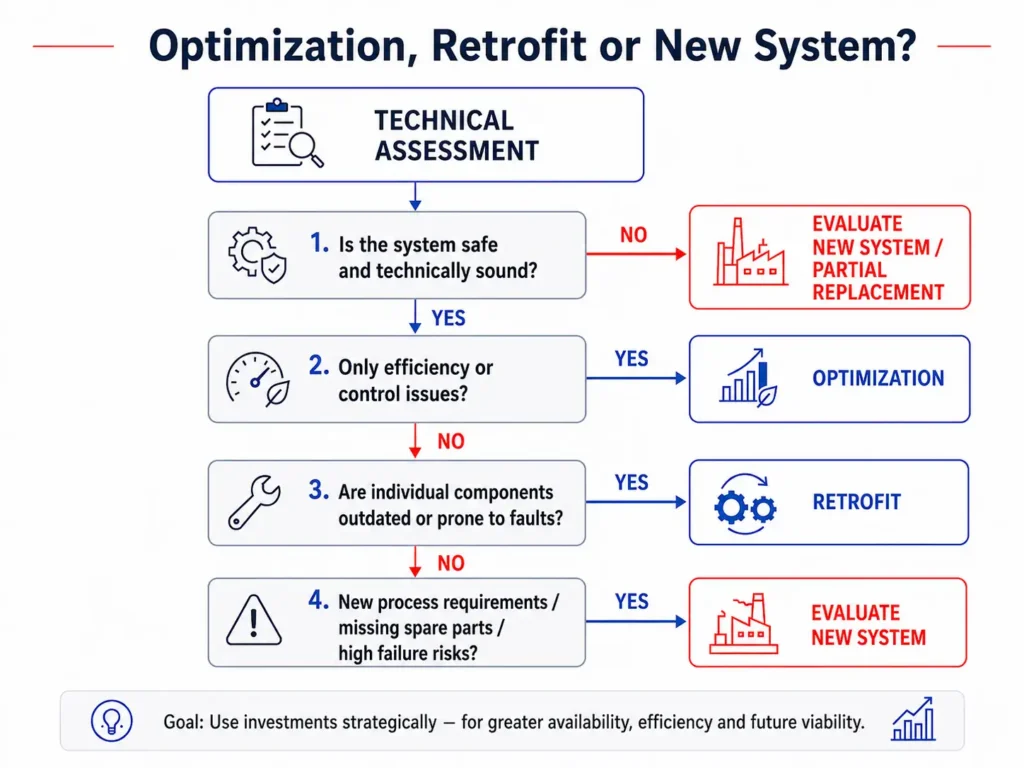
Note on point 3: If the heater is objected to during recurring inspections or is not approved for repair, replacement or recommissioning, this can significantly shift the decision toward retrofit, partial renewal or a new system.
When is optimization sufficient?
Pure optimization is sensible when the system is fundamentally intact and there are no serious safety or availability problems.
Typical examples:
- adjusting burner control
- adding insulation
- improving maintenance intervals
- evaluating thermal oil analysis more consistently
- cleaning heat exchangers
- optimizing control parameters
- minor sensor or monitoring additions
- checking waste heat potential
These measures are often relatively easy to plan and can sometimes be integrated into existing maintenance windows. They are particularly suitable when the process remains unchanged and the system is only to be operated more efficiently or more reliably.
When does a retrofit make sense?
A retrofit goes further than pure optimization. Individual components are selectively modernized while essential parts of the system remain in place.
Typical retrofit measures:
- replacement of the control system
- modernization of the burner
- replacement of the heater
- renewal of pumps or pump stations
- retrofitting sensors and safety monitoring
- replacement of individual heat exchangers
- addition of a flue gas heat exchanger
- conversion of partial circuits or consumer stations
- modernization of electrical, instrumentation and control technology
A retrofit is particularly interesting when the system body, piping system and basic design are still usable, but individual components have become outdated, inefficient or prone to failure.
When is a new system the better option?
A complete new system becomes more realistic when the existing system can no longer be sensibly upgraded from a technical, safety-related or economic perspective.
Possible triggers:
- cracks, corrosion or irreparable damage to the heater
- recurring leaks
- severely aged or repeatedly damaged thermal oil
- lack of spare parts
- outdated control system without documentation
- new production requirements
- significantly higher or different temperature levels
- change of energy source
- retrofit would cost almost as much as a new system
- operating permit or conformity could only be restored with major effort
In such cases, a new system can make more economic sense even if the initial investment seems higher. Failure risk, maintenance costs, safety risks and energy-related disadvantages can make an apparently inexpensive existing system expensive in the long term.
Decision matrix: which direction fits?
| Condition / goal | Optimization | Retrofit | New system |
| System mechanically intact | very suitable | possible | usually not necessary |
| Control system outdated | limited | very suitable | usually not necessary |
| Burner inefficient | possible | well suited | usually not necessary |
| Heat exchanger fouled | cleaning sensible | replacement possible | usually not necessary |
| Thermal oil values abnormal | check cause | depending on cause | usually not necessary |
| Recurring leaks | critical | only after root cause analysis | usually not necessary if the cause can be controlled |
| Spare parts unavailable | limited | well suited | sensible if there is an overall risk |
| New process requirements | rarely sufficient | project-dependent | often sensible |
| Change of energy source | limited | project-dependent | usually necessary when switching to steam or hot water |
| Safety concept outdated or no longer permissible under current standards | check | often sensible, especially at the heater | if retrofitting is not economically or technically feasible |
The matrix does not replace a technical assessment. However, it shows how operators can structure the decision. The key point remains: Only when the actual condition is known can measures, risks and approximate investment costs be determined reliably.
How can economic viability be assessed?
For technical managers and managing directors, the final question is not only whether a measure is theoretically possible. It must also be economically understandable.
The simplest calculation is:
Payback period = investment / annual savings
Example:
| Item | Value |
| Investment in optimization measure | $18,000 |
| annual energy savings | $4,500 |
| reduced maintenance / malfunction costs | $1,500 |
| total annual savings | $6,000 |
| simple payback period | 3 years |
This calculation is deliberately simple. It helps with the initial classification, but falls short if only energy is considered. In heat transfer systems, production downtimes, scrap, quality fluctuations and repair costs also play a major role.
A second example:
| Assumption | Value |
| unplanned downtime | 4 hours |
| internal production loss | $2,500/h |
| cost of one shutdown | $10,000 |
If modernization prevents only one such shutdown, it can already be economically relevant, even if the pure energy savings seem manageable. An assessment should therefore consider at least four levels:
- energy savings
- maintenance and spare parts costs
- downtime and failure risk
- process stability and production quality
For larger projects, CAPEX/OPEX comparison, eligibility for subsidies, CO₂ costs, remaining service life and strategic site considerations are also relevant.
Practical procedure
Sensible modernization does not follow a standard recipe. A step-by-step approach has proven effective:
| Step | Goal |
| 1. Data collection | record temperatures, outputs, flow rates, energy consumption and malfunctions |
| 2. System inspection | assess heater, piping, pumps, heat exchangers, sensors and safety |
| 3. Prioritize weaknesses | What is relevant in terms of energy, safety and economics? |
| 4. Develop measure variants | compare optimization, retrofit, partial renewal and new system |
| 5. Calculate economic viability | evaluate investment, savings, downtime, maintenance and remaining service life |
| 6. Plan implementation | prepare shutdown windows, installation, commissioning and documentation |
| 7. Monitor effect | track consumption, control behavior, malfunctions and thermal oil condition |
For many operators, the variant assessment is the decisive step. Not every system needs to be replaced immediately. But not every old system should continue to operate simply out of habit. The most economical path is often somewhere between the two extremes.
You can find further technical classifications around heat transfer media and industrial process heat in the technical articles by Rothos Energy Systems, for example in the article thermal oil, steam or water: which solution fits industrial process heat?.
Conclusion: assess first, then invest
Existing heat transfer systems often offer more optimization potential than is visible at first glance. Control systems, burners, heat exchangers, pumps, insulation, waste heat recovery, maintenance and thermal oil analysis can help operate a thermal oil heater system more efficiently, safely and economically.
At the same time, every optimization has its limits. If safety-relevant damage occurs, spare parts are unavailable, process requirements have changed significantly or a retrofit no longer makes economic sense, a new system may be the better decision.
The most important step is therefore a technical assessment. It creates the basis for a reliable decision: continue optimizing, modernize selectively or plan a new system.
Rothos Energy Systems supports industrial companies in the assessment, planning and implementation of custom heat transfer systems – from the modernization of existing heat transfer systems to complete new systems.
Would you like to have an existing heat transfer system assessed? Contact Rothos Energy Systems.